
NA HOPENA O KE KAUA: A New Era of American War, International Instability & Hawaii’s Economy
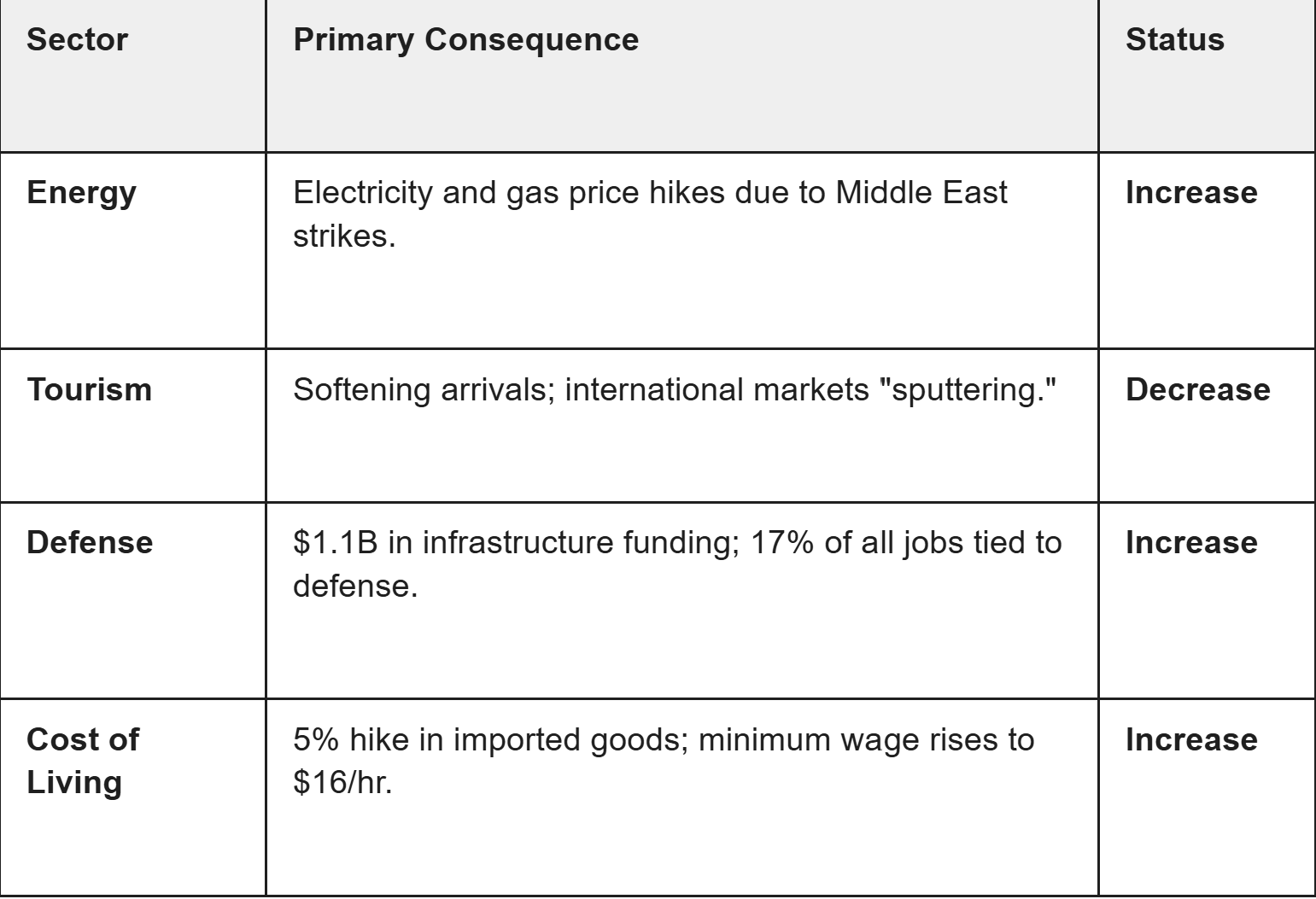
2026 is less than three months old, and the United States finds itself at the precipice of a third world war. Recent conflicts around the world - but particularly escalations in Ukraine, Gaza, and Iran - have triggered unprecedented political and economic effects. These effects may possibly impact Hawai’i in ways we can’t yet foresee accurately, but must prepare for regardless. This essay identifies a few notable areas of potential impact: energy, tourism, defense, and cost of living.

Image credit: US Army - Joint Base San Antonio
PARADISE’S PRICE WILL RISE
Because Hawaiʻi remains the most petroleum-dependent state in the US, instability in the Strait of Hormuz will create higher energy and utility costs. This energy volatility is not some fluke or an abstract market trend; it is an immediate tax on every household and business in the pae ‘āina, complicating the state's inconsistent push toward renewable energy.
The conditions which already make Hawai’i expensive are worsened by what analysts have labeled "tariff vertigo": Supply chain interruptions caused by or in reaction to the 2022 invasion of Ukraine have evolved into a broader international trend of economic protectionism and shipping disruptions. Because more than 80% of all Hawaii’s goods are imported, these interruptions and supply shortages are felt at grocery stores, shopping malls, and even construction sites.
While Matson and other domestic carriers maintain stable volume, exchange between Hawai’i and China has rapidly declined, and the 5% increase in the cost of imported materials recorded over the last year is now all but integrated into the local inflation rate. This has led the University of Hawaiʻi Economic Research Organization (UHERO) to revise its outlook to a “mild recession”, as high fuel surcharges also begin to deter the international tourism Hawai’i has increasingly relied upon since the 1950s for revenue.
(THE GARRISON) STATE OF HAWAI’I
The political conflicts and policies which have made Hawai’i more expensive for her people have also given Governor Josh Green and the state unprecedented leverage to deal with the federal government.
There’s an idea called the "Garrison State paradox” that seems to be taking shape right before our eyes. It’s a circumstance wherein the local/non-DoD/civilian economy struggles with the economic costs and consequences of war, while military installations and personnel residing in Hawai’i are infused with historic levels of funding. The FY2026 National Defense Authorization Act (NDAA) has designated over $1.1 billion for “local infrastructure” which, from a certain point of view, could be characterized as a vital stabilizer against a deeper economic downturn. However, this influx of federal funds is a direct response to the need to modernize the US’s tactical Pacific training grounds. Consequently, while the native Hawaiian community argues for the return of Hawaiian land that the federal government seized and occupied without treaty, after the 1893 overthrow, the US military is on the verge of widening and deepening their footprint on Hawaiian soil.
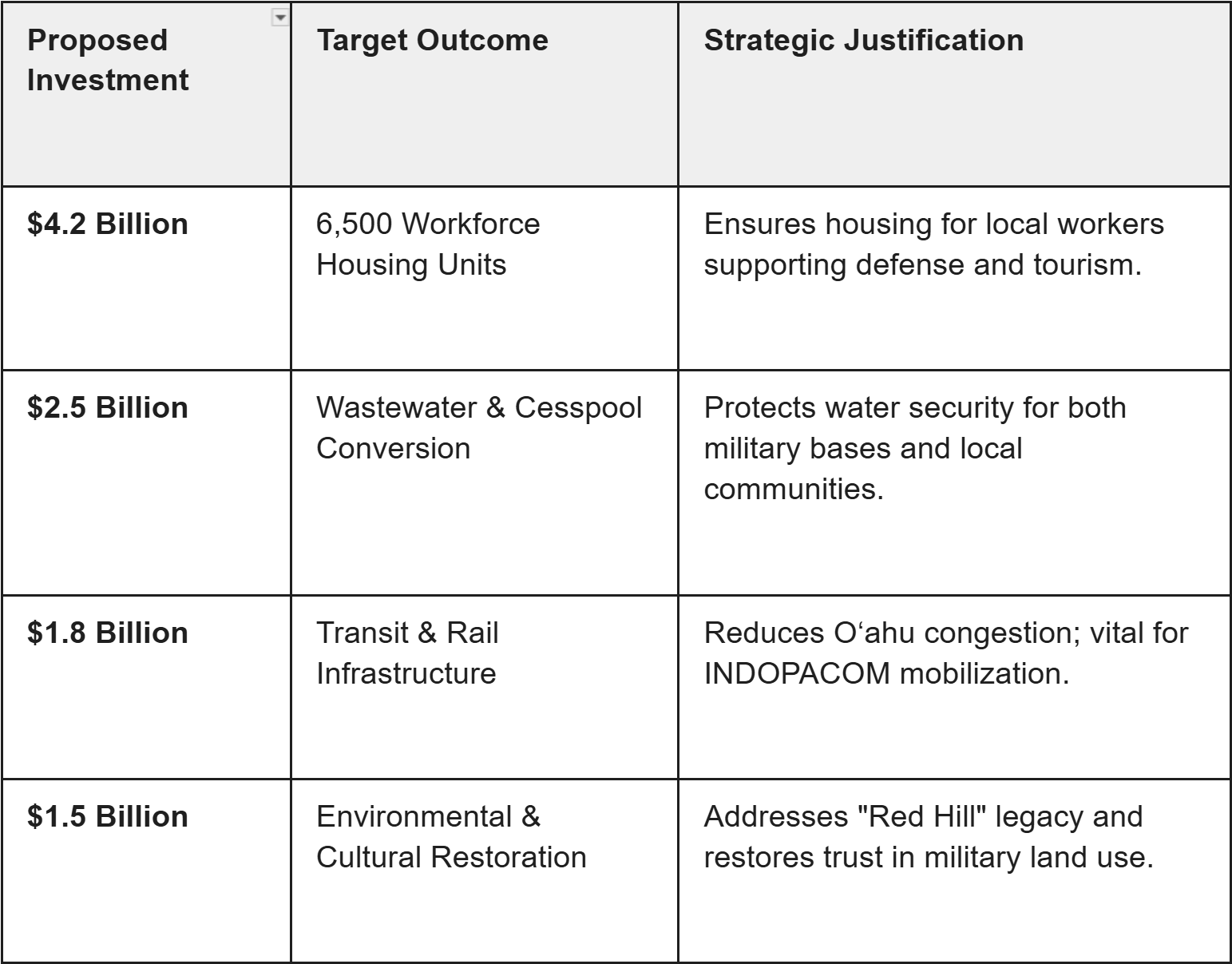
As a result, the current negotiation between Governor Josh Green and the federal government regarding 29,000 acres of military-leased land has now become Hawaii’s most significant political leverage. As critical leases are set to expire in 2029, the state sees the threat of war-buildup and economic instability as ample justification to demand a $10 billion investment package - featuring major earmarks for housing and environmental improvement projects. Still, Israel’s US-backed war in Gaza and Iran has intensified both the push for and popularity of demilitarization and indigenous sovereignty.
The proposed $10 billion land lease negotiation between the State of Hawaiʻi and the federal government has been characterized as a "New Deal" for the Islands. Its potential benefits would be primarily aimed at the economic shortfalls worsening the current housing crisis. As of March 2026, the strategy centers on leveraging the military's urgent need for long-term certainty over 29,000 acres of critical training land—specifically at Pōhakuloa on Hawaiʻi Island and several sites on Oʻahu—in exchange for massive federal investment in civilian infrastructure.
If conflicts in Europe, Asia, and the Middle East worsen and fighting increases, competing influences over the control of Hawaiian land and its use will create a complex and tense political landscape. One wherein the state must balance the economic advantage of a massive federal investment and increased military presence against the ever-growing internal pressure for community-led environmental sustainability initiatives, broader cultural stewardship, and the long-awaited return of historic Hawaiian crown and kuleana lands to the Hawaiian people.
THE $10bn QUID PRO QUO
The most tangible consequence for local residents would be the direct funding of 6,500 new housing units. These homes are specifically targeted at blue-collar and middle-income families. Unlike traditional development, this package aims to use federal "defense community" grants to bypass the high capital costs that usually stall such projects. By framing housing as a matter of "regional stability" and "personnel readiness”, Governor Green’s administration is attempting to secure a rare type of funding which would not rely on Hawaii's fluctuating tax base. This is particularly critical as UHERO’s 2026 forecast indicates a slowdown in private residential construction, due to the increasing cost of imported materials.
Beyond home-building, a big chunk of the $10 billion package is being eyed for wastewater and "firm" infrastructure. This would include the accelerated conversion of thousands of cesspools—a multi-billion dollar mandate that currently threatens the financial well-being of many local homeowners.
By linking these urgent civilian infrastructure and environmental improvements to the land lease renewal negotiations, the state could possibly offload a historic generational debt onto the defense budget of the US government. Additionally, the proposal includes provisions for the Skyline in the form of an expansion to the rail. It argues that a functional transit corridor is essential for the movement of both the civilian workforce and the 40,000+ military personnel stationed on Oʻahu.
THE COMING STORM
While a possible economic windfall is in the cards, Hawaii’s political narratives are at odds with the US’s immediate strategic needs, putting the long-term security of both Hawai’i and the United States at risk.
Tense negotiations are proceeding against a backdrop of heightened skepticism regarding the military's environmental footprint, following the political fallout and final decommissioning of the Red Hill Bulk Fuel Storage Facility in 2025. Proponents of the $10 billion package argue it’s a pragmatic way to turn a geo-political burden into many tanigible local benefits. Conversely, native Hawaiians, Hawaiian sovereignty advocates, and environmental groups remain concerned that a 65-year lease extension (currently being considered) would permanently solidify the "Garrison State" model, regardless of any benefits to affordable housing, the rail, or infrastructure and utility investments on Hawai’i Island and O’ahu.
All eyes should be on the U.S. Department of Defense as it finalizes its "Integrated Land Use Plan" to meet the FY2027 budget cycle. If successful, this deal would mitigate the "mild recession" currently projected for late 2026, but could fundamentally alter the state government's fiscal trajectory for the next half-century, while simultaneously damaging its relationship with Hawaii’s people.
SOURCES
DBEDT (Department of Business, Economic Development & Tourism). "Hawaiʻi's Economic Outlook 2026." (Jan 2026).
Oxford Economics. "The 2026 Iran War, An Initial Take and Implications." (March 1, 2026).
UHERO (University of Hawaiʻi Economic Research Organization). "Mild Recession and Weak Recovery in 2026." (Feb 2026).
Hirono.senate.gov. "Senate Passes FY26 NDAA: Key Provisions for Hawaiʻi." (Dec 2025).
Courthouse News. "With military land leases expiring, Hawaii moves into unique negotiating position." (Feb 2026).
Matson, Inc. "Fourth Quarter and Full Year 2025 Results; 2026 Outlook." (Feb 2026).
CFR (Council on Foreign Relations). "Conflicts to Watch in 2026." (Jan 2026).
Office of the Governor, State of Hawaiʻi. "The $10B Leverage: Federal Investment and Land Lease Negotiations." (Jan 2026).
Honolulu Civil Beat. "The Price of Presence: Inside the 2029 Land Lease Talks." (Feb 2026).
UHERO. "Economic Impacts of Federal Infrastructure Injection in Hawaiʻi." (Feb 2026).
U.S. Department of Defense. "Pacific Basing and Community Resilience Report." (Dec 2025).
