
THE POLITICS OF HAWAIIAN PRIORITY & the DHHL
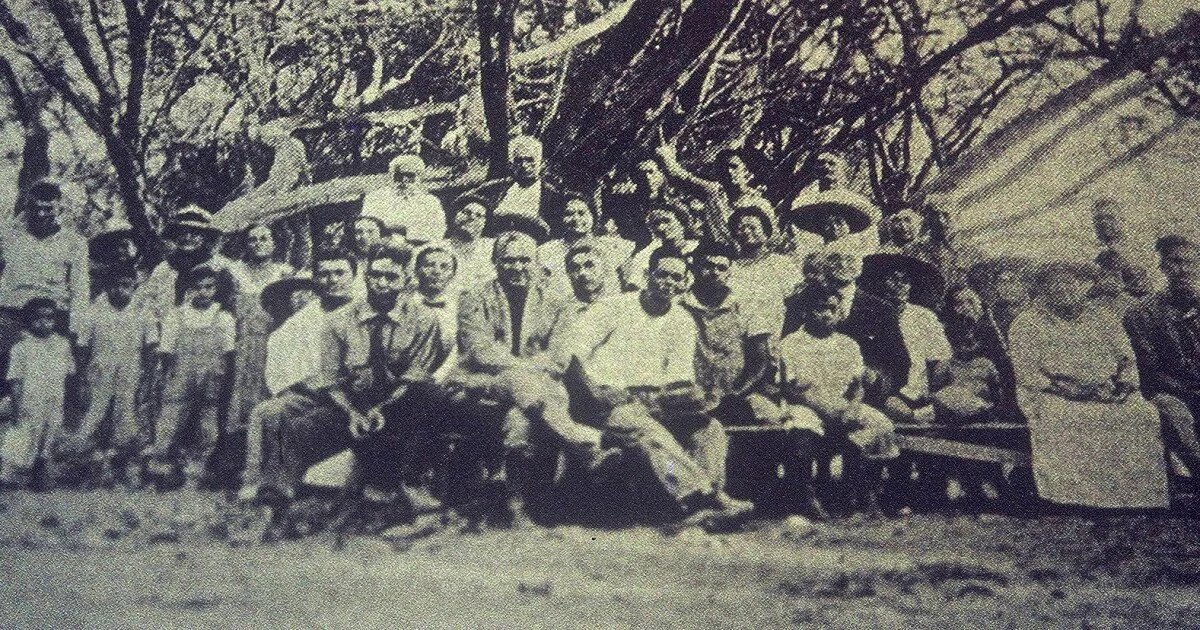
Kalamaula, Moloka’i. Native Hawaiian families who received the first homestead lots under the pilot program of the Hawaiian Homes Commission Act of 1921. Image courtesy of the Department of Hawaiian Home Lands
Imagine you live on a modest piece of land. You’ve built a house, planted an orchard, raised a few kids who have their own families now, and buried your grandparents under the century-old tree out front. One afternoon, a bureaucrat in fancy clothes knocks on the door, accompanied by a surveyor and an eager real estate investor.
"Good news," he says. "We ran the numbers. A luxury condo developer and a multinational crypto exchange could use this land to produce–well, much more than your family ever could. Therefore, in the name of the greater good, we’re converting your deed into a general raffle ticket. You have the exact same right to buy a condo here as any other visitor from the mainland landing at the airport tomorrow. Sounds good?"
This would offend me. My reaction would likely be very offensive. Yours?
This type of drama generally plays out across entire continents. For centuries, western governments and academics have agonized over a deeply uncomfortable question: Do indigenous people retain an inherent priority to live on and govern their historic homelands, or does that claim expire whenever the wider world decides it has a better, more lucrative, or more urgent use for their land and resources?
If you listen to the more bloodless corners of academic philosophy, you might hear this debated as an abstract puzzle of "competing rights”. That’s part of the story. The reality is actually a sad account of the catastrophic failure of "blank slates”, as well as the well-meaning traps of paternalism, and the stubborn truth that you cannot truly own a home if someone else holds the master key to your front door.
The "Blank Slate"
Every few decades, an earnest crop of political reformers discovers what they believe to be the ultimate solvent for historical injustice: uniform equality. The pitch goes like this: "Why look at history at all?" the liberal economist asks. "Looking backward is messy, bitter, and tribal. Let’s wipe the slate clean. No special statuses. No racial or ancestral categories. Just one uniform set of individual property rights for every citizen, governed by the neutral magic of the open market. Everyone gets an identical starting line!"
It sounds modern and democratic. It also happens to be a con.
When governments road-test the "blank slate" on indigenous populations, it never produces a thriving class of self-reliant yeoman farmers. It creates lightning-fast, catastrophic dispossession.
Take the United States in the late nineteenth century. Congress convinced itself that the most humanitarian thing it could do for Native Americans was to liberate them from collective tribal ownership. Enter the Dawes Act of 1887. The plan was to carve up collective reservations into tidy, private 160-acre parcels for individual tribal members, and sell off the "surplus" leftovers to non-native settlers.
It became an unmitigated disaster. Over the next half-century, roughly ninety million acres of tribal land vanished into thin air. When a people, who have lived communally for millennia, are stripped of its collective institutions, left without access to credit or capital, and forced into a predatory private real estate market rife with cons and speculators, the outcome is a fire sale - not economic prosperity. Predatory loans, bewildering tax foreclosures, and outright fraud dispossessed tens of thousands of natives.
By the 1950s, the exact same bad idea was back in fashion. It’s known as the "Termination Era”. Congress decided to simply erase tribal recognition status, liquidate reservations, and declare everyone formally equal under state law. The Menominee of Wisconsin, for instance, were suddenly "liberated" into a county of their own—where their community hospital immediately collapsed because it couldn't meet state regulatory codes, their local economy cratered, and poverty skyrocketed. The failure was so significant, and the native blowback so angry, that even the federal government eventually understood the mess it created, apologized, and spent the 1970s hastily rectifying the policy.
The same tragic comedy played out across post-colonial Latin America in the 1800s. Newly minted liberal republics abolished communal indigenous titles in the name of civic equality. Within a few short decades, those lands were absorbed into massive commercial haciendas, converting self-sustaining indigenous farmers into impoverished, landless wage-laborers.
The philosophical lesson here is simple and utterly harsh: treating two groups with vastly unequal starting conditions, wealth reserves, and cultural institutions as "identical” under some uniform policy does not produce fairness. It accelerates a condition in which the economically strong deprive the poor of their quality of life.
The "blank slate" is never blank; it is pre-printed with the house rules of whoever already holds the wealth.
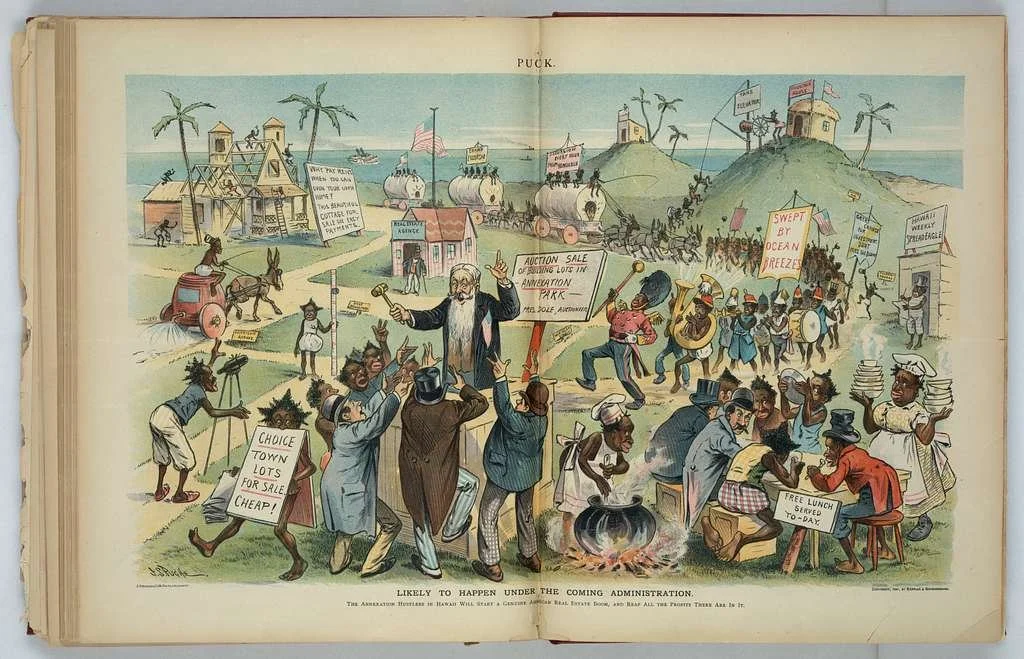
Likely to Happen Under the Coming Administration (Subtitle: The Annexation Hustlers in Hawaii Will Start a Genuine American Real Estate Boom, and Reap All the Profits There Are In It.) by J. S. Pughe; December 2, 1896 (published as a centerfold color lithograph cartoon in Puck magazine, Vol. 40, No. 1030)
The Inconvenient Consensus
Because the historical record is rife with examples of economically self-inflicted catastrophe, no serious economist, philosopher, or policy wonk today advocates for the pure blank-slate approach. The idea that indigenous peoples have zero unique claim to their ancestral lands is so fringe that it smacks of overt racism.
A modern consensus has begun to form over a fundamental premise: indigenous communities do in fact have a profound, legitimate right of priority to remain on their historic territories.
Why? Because losing land isn’t just about property value. Land is an indigenous community’s archive, the cemetery, the meeting hall, the grocery store, and the classroom all rolled into one. If a suburban accountant gets priced out of his neighborhood and moves three towns over, his life is disrupted, but his English syntax remains intact, his stock portfolio moves with him, and his basic cultural identity survives. If an indigenous group is displaced from the specific mountains, rivers, and shores that define its worldview and social kinship, the result is cultural amputation. The utility loss, as economists would call it, is severe and irreplaceable.
Indigenous priority is real. But the fact that the priority is real is not the problematic issue.
Trouble seems to begin when policy administrators start arguing with the community they serve about what happens when that priority starts to become inconvenient. What happens when an indigenous community’s desire to keep its territory untouched collides head-on with a pressing crisis faced by the broader population?
Imagine a situation where the state justifies “serving a rural community” by hastily paving a new road or burying high-power electrical lines across kuleana lands. Or consider a sudden, catastrophic natural disaster (like Lahaina in 2023) that creates refugees of the local population. A situation where the state incidentally opens the door to commercial speculators and foreign real estate investment in the name of “rebuilding”.
Here, the debate divides into two camps:
The High-Threshold Camp: These theorists treat priority as near-sacred self-determination. They argue that an indigenous group’s right to its territory can only be overridden in the most extreme, Hollywood-disaster-movie scenarios—hemisphere-wide mass starvation, nuclear war, or interplanetary invasion. Outside of absolute survival emergencies, if the community says "no," the answer is no. Economic development, public convenience, and infrastructure be damned.
The Balancing Camp: They agree that indigenous priority carries immense moral weight, but they reject the idea of an absolute veto. Societies, afterall, are messy, interdependent webs of human needs. If an entire nation is in critical need of clean water, regional mass transit, or critical infrastructure that cannot reasonably go anywhere else, the right of priority can be negotiated or constrained—but only if the process involves meaningful consultation, substantial compensation, and zero existential threat to the community’s cultural continuity.
The problem genuinely isn't about whether priority exists. It's about whether that priority functions as an impenetrable fortress, or a very heavy weight on a delicate set of scales.
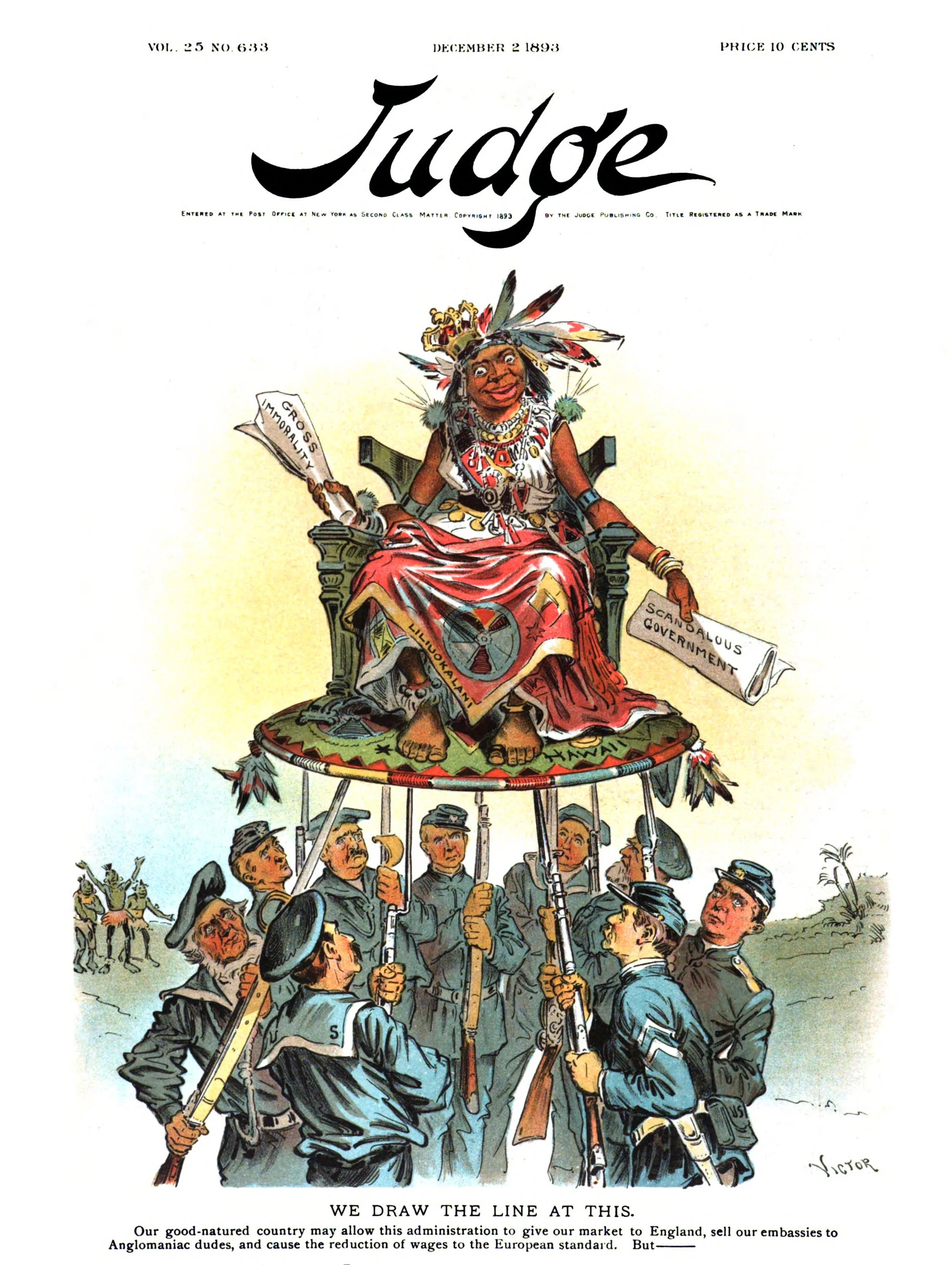
“We Draw the Line at This.” by Victor Gillam; December 2, 1893 (published as the cover of Judge magazine, Vol. 25, No. 633)
The Landlord State: The Hawaiian Homes Experiment
Thinking about these principles in the abstract is one thing. It is quite another to see them codified into law by ethically-flexible politicians trying to appease corporate interests while throwing a bone to a dispossessed population.
However, the quintessential, real-world case study of what happens when a government tries to invent a right of priority without fully appreciating the cultural consequences is the Hawaiian Homes Commission Act of 1920 (HHCA).
At the end of the 19th century, the US was cementing its control over the islands. Following the illegal 1893 overthrow of the Hawaiian Kingdom and subsequent annexation by the United States, the indigenous population was facing staggering demographic decline, widespread landlessness, increased incarceration, poorer health outcomes, and urban displacement. Native Hawaiians were in socio-economic freefall.
Prince Jonah Kūhiō Kalanianaʻole, Hawaiʻi’s delegate to Congress, understood the potential disaster of applying the "blank slate” approach to Hawai’i. He knew that if native Hawaiians were simply expected to compete in the open market against the sugar and pineapple plantation juggernauts or the colonial merchant houses, they would be wiped out entirely.
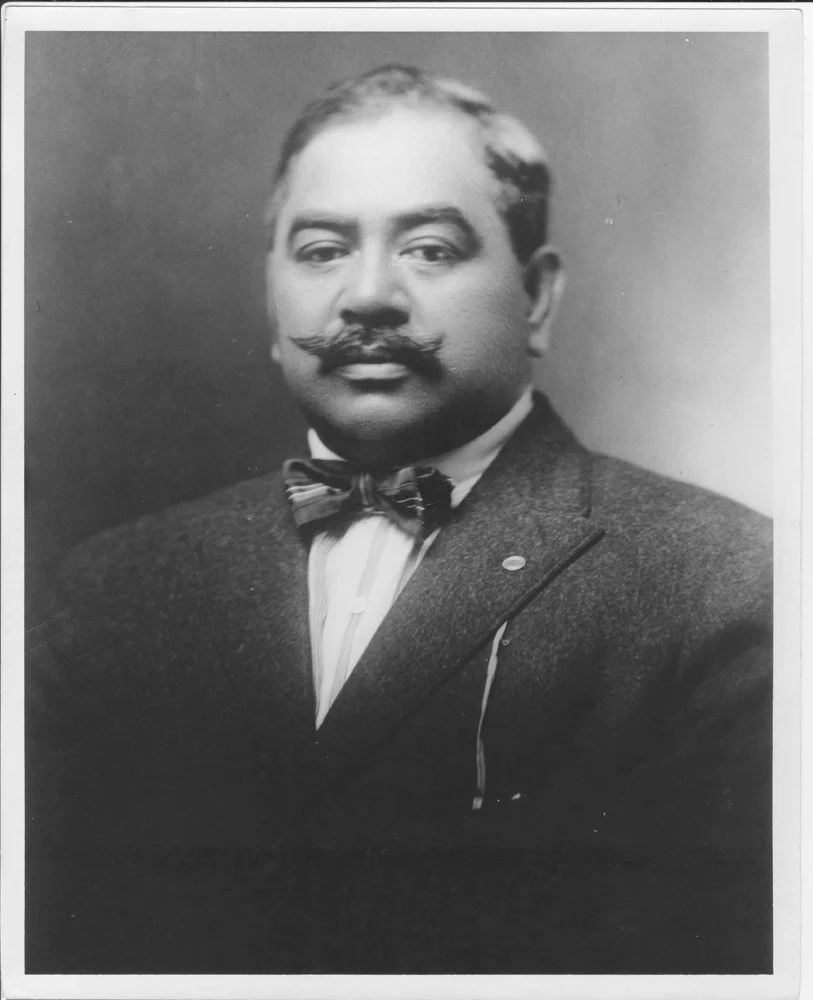
Prince Jonah Kūhiō Kalanianaʻole (March 26, 1871 – January 7, 1922); Prince of the Kingdom of Hawai’i, delegate of the Territory of Hawaii to US Congress
Kūhiō fought for a then-radical institutional intervention: establish an inalienable public land trust to get Hawaiians back on the land. In 1920, Congress passed the Act, setting aside roughly 203,000 acres of former Crown and Government lands for ninety-nine-year homestead leases at the price of $1 a year. Crucially, the land could not be sold or transferred on the open speculative market.
On paper, this was a monumental rejection of the blank-slate model. It explicitly recognized that native Hawaiians possessed a special, prior claim to the soil that transcended ordinary market economics.
Yet, the HHCA is built out of compromises so damaging that it nearly crippled any good the law did from day one.
There was a political compromise over the land itself. When Kūhiō went to Washington, powerful sugar barons and cattle ranching syndicates descended on Capitol Hill to protect their profits. They ensured the Act barred any "prime" agricultural land currently under lease to the plantations from being included in the trust. What was left after this carve out? Roughly 200,000 acres composed largely of arid lava fields, steep gulches, and remote parcels lacking water, roads, or electricity. Handing an impoverished family a plot of land with no running water and miles of jagged basalt is like handing a starving person a can of soup without providing a canopener, bowl, or spoon: theoretically generous, but impractical and somewhat cruel.
Then came the blood quantum requirement. To secure the bill’s passage, conservative lawmakers insisted that only those with at least 50% Native Hawaiian blood could qualify for an initial homestead lease. By this compromise, a wholly Western concept of genealogy and legal apparatus replaced traditional kinship and social ties with an inevitable generational stopwatch. Over time as people naturally fell in love and had children across Hawaiʻi’s multicultural landscape, the pool of eligible beneficiaries steadily shrank, creating traumatic administrative rifts within the very families the Act was supposed to protect.
Finally, and most fatally, the Act created the ultimate bureaucratic paradox: the waitlist.
Because the lands included in the trust lacked basic infrastructure, preparing them for actual human habitation required serious money. For decades even before statehood, the government of Hawai’i underfunded the Department of Hawaiian Home Lands (DHHL). The agency found itself trapped in a bizarre bureaucratic circle: it didn't have the money to build water lines and roads for homes, so it leased out pieces of the trust land to commercial strip malls, industrial yards, and private businesses just to generate enough operating cash to keep going.
The result is a quiet, generational tragedy that continues to unfold today. Tens of thousands of Native Hawaiian applicants wait in excess of twenty, thirty, or forty years, with thousands dying before their names are ever called. Landmark class-action lawsuits like Kalima v. State of Hawaiʻi and historic, multi-million-dollar legal settlements eventually forced the state to acknowledge that dragging an administrative process out until the claimants expire is a profound breach of fiduciary duty.
But despite every structural defect, nobody characterizes the Hawaiian Homes Act a complete failure. Had those 203,000 acres been dumped onto the free market in the 1920s or during the mid-century tourism boom, they would have been snapped up by resort developers, luxury estates, and corporate agribusiness within an afternoon. Today, those homesteads form the bedrock of resilient, vibrant Native Hawaiian communities across Molokaʻi, Maui, Oʻahu, and Hawaiʻi Island. It kept the land from being forever alienated from the indigenous community who values it most.
The HHCA wasn't an outright success, and it wasn't a waste of time. It was an uneasy, poorly-compromised hybrid—a public land trust created to keep people rooted, operating inside an administrative system that constantly dragged its feet.
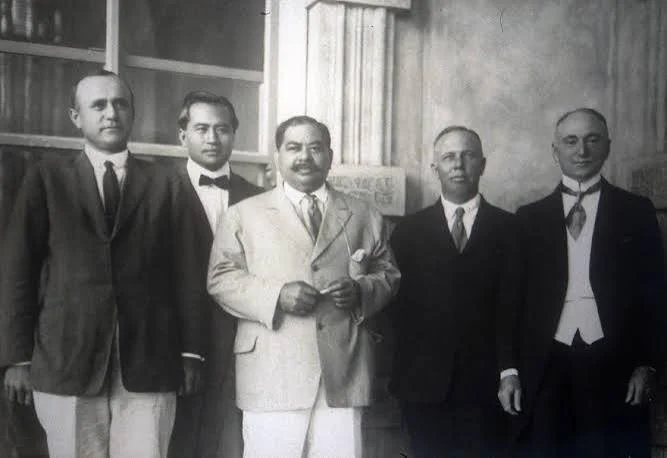
September 16, 1921; The first members of the Hawaiian Homes Commission following the passage of the Hawaiian Homes Commission Act of 1921. (L-R) Rudolph M. Duncan – Commission member and prominent civic leader (superintendent of the Honolulu Rapid Transit & Land Co.); Rev. Akaiko Akana – Commission member and influential pastor of Kawaiahaʻo Church; Prince Jonah Kūhiō Kalanianaʻole – Commission member and Hawaiʻi’s Congressional Delegate who spearheaded the Act; George P. Cooke – Executive Secretary/Officer of the Commission (and Molokaʻi rancher/senator); Wallace Rider Farrington – Governor of the Territory of Hawaiʻi and ex-officio Chairman of the Commission. Image preserved in the Hawaiʻi State Archives and Department of Hawaiian Home Lands historic collections.
Why Priority Without Autonomy is Doomed to Fail
Studying the Hawaiian Homes experience leads straight to the heart of the deepest philosophical question of the whole debate:
Can an indigenous community truly possess a right of priority to its land if it does not possess the political autonomy to govern it?
In short, the answer is an emphatic no. It can’t and never could.
When a dominant state grants a certain group a "right of priority" while withholding political autonomy, it fundamentally changes the nature of the relationship. For indigenous people, whole communities are no longer treated as a self-determining sovereign entity; it is transformed into an administrative client.
Think of the contrast between an owner living in their own home versus a tenant living under a well-meaning but eccentric landlord: if you are an autonomous homeowner, you decide how things are run in your household; if you are a tenant in a state-run trust, the landlord typically retains absolute control over the property. The landlord makes the rules for who qualifies as a legitimate resident (like a 50% blood quantum rule). The landlord decides whether the annual budget will cover fixing the broken roof this year or if you’ll have to wait another decade. The landlord decides whether to carve off part of the backyard and lease it to a commercial storage company to pay for the maintenance crew.
Most dangerously of all, the tenant has to constantly petition, plead with, and lobby the landlord just to receive what was promised. If the broader public—the majority voting bloc that elects the state legislature—decides that other political priorities are more pressing than funding the priorities of the indigenous community, then those priorities simply wither on the vine.
It’s what academics call politics of recognition. When a powerful state acknowledges an indigenous claim purely through an administrative, paternalistic lens, it essentially waters down the urgency of their claims as well as the validity of their rights. It’s the language of an indifferent bureaucrat, saying "We recognize your special attachment to this soil, and in return, we will manage it for you, define who you are, and parcel it out to you on our schedule.”
Real territorial priority requires more than just an administrative permit to build a roof over your head. It must be supported by jurisdiction.
It requires the legal and institutional power to manage the zoning, govern the resources, control the surrounding watershed, adjudicate disputes through your own community standards, and define your own civic boundaries. Without a jurisdictional shield, anyone’s right to occupy their indigenous lands will always exist on borrowed time. In order to survive, native Hawaiians must reduce their vulnerability to the inconsistent political will of state lawmakers, budget cuts, bureaucratic lethargy, and the relentless pressure of development.
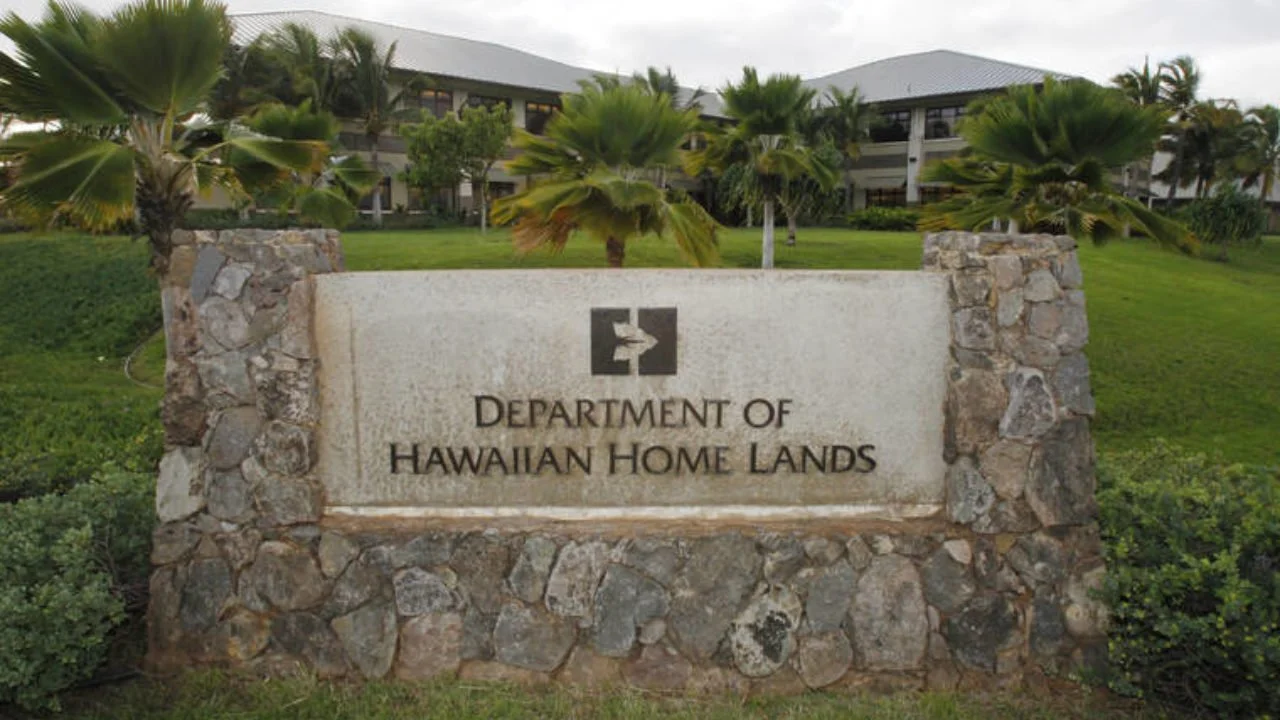
Hale Kalanianaʻole, DHHL Headquarters, in Kapolei.
Beyond the Paternalistic Trap
Where does this leave the broader argument?
Human societies are complicated, historical realities are messy, and the world is crowded. We cannot wind the clock back centuries to undo past wrongs, nor can we rationally argue that non-indigenous Hawai’i locals—many of whose families have lived in a region for generations and built their own lives, homes, and ties to the soil—possess no skin in this game, either.
The blanket "free market" fantasy that treats ancient lands as fungible commodities ready for a blank slate is an engine of destruction. It has been tried, repeatedly and enthusiastically, and every single time it has ended in displacement, cultural ruin, and entrenched poverty.
Territorial priority for indigenous people to their historic lands is not an archaic relic or an unfair ethnic privilege. It is an indispensable, structural safeguard. It is the recognition that indigenous people cannot survive as a distinct culture if the very ground beneath their feet is constantly being traded away from them. The great lesson of the last century—from the broken promises of the reservation era to the agonizing waitlists of the Hawaiian Homes trust—is that land rights without governing rights are (and always will be) a half-measure.
If a society genuinely wants to honor an indigenous right of priority, it cannot settle for casting itself as a benevolent trustee managing a pool of disenfranchised applicants. It has to be willing to share actual power. It has to grant the self-governing autonomy that turns an administrative claimant into a true decision-maker.
Because, ultimately, if you have to spend fifty years standing in a government hallway, holding a number, waiting for a bureaucrat to decide whether you're allowed to go home, then you were never a priority and your rights never actually mattered.
