
TO REVIVE A HAWAIIAN NATION: On Deoccupation and Decolonization
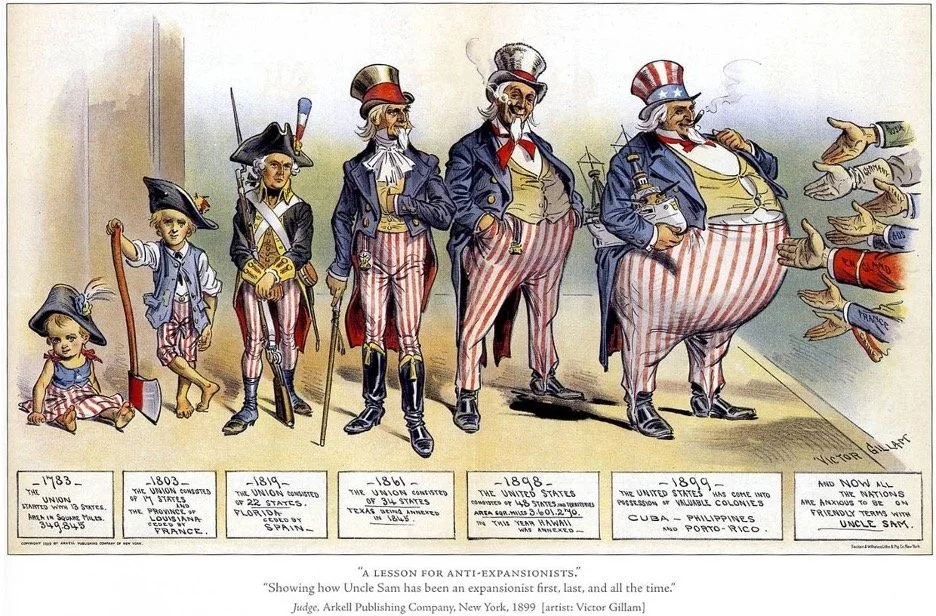
“A lesson for Anti-Expansionists”, by Victor Gillam; Arkell Publishing Company, New York, New York, 1899
Colonialism is another way to describe invasion.
As a concept, it’s generally understood as the actions of one country claiming and forcing political and cultural control over another nation or culture - including the people who live there, as well as its land and territory. As invasions go, it’s not necessarily a savage one; there are crueler, bloodier, and more violent forms of invasion. It could come like waves of unwanted and unchosen change, drowning all those being invaded. The change can be abrupt or gradual. Sometimes it’s rationalized under the guise of a legal process, patriotism, or divine will. Sometimes it’s missionaries bringing spirituality; or foreign soldiers there to “keep the peace”; or even wayward settlers trying to build a new life far from their historic and ancestral homelands. Colonialism adopts and adapts to many forms. But whereas invasions in open war are almost always an obvious show of tactics, violence, or nationalistic loyalty, colonialism invades in ways that operate more subtly and perniciously.
Historically, colonialism was attractive to powerful countries because it granted access to greater wealth and resources than what the colonizer could produce domestically. Access to these resources and wealth manifests as political power in the form of rigid control. Profits and benefits from this control were almost always used to enrich those who colonize, at the expense of those being colonized.
Generally, the process begins in earnest when colonizing countries send their own people to live with and among the colonized. They impose new rules, promote new customs, and uphold new sets of social ethics. The colonizer’s own language and traditions grow in emphasis with time, supplanting or replacing the language and culture of the colonized in their own historic lands. By the numbers, about 476 million people, across 90 countries worldwide, live in this condition or one very similar to it. In 2026, there are approximately 5,000 distinct indigenous cultures living under the rule of governments whose control is an outgrowth of historic colonialism – control born of the illegal use of force or intimidation.
When indigenous communities around the world seek to break free of a colonizer’s control over their autonomy, two ideas often consume the debate: deoccupation and decolonization. While the terms may feel identical or synonymous, they actually describe fundamentally different challenges, aim for different goals, and succeed under different contexts and conditions.
To clarify the difference between the two, let's imagine a family home that has been taken over by a mob of uninvited squatters. Against the law and the family’s wishes, the squatters effectively control every meaningful aspect of the home despite the fact that no family member gave them rightful permission to be there or do so. Let’s say the family chose to deoccupy their home of the criminally uninvited guests. In that case, it would be like calling on the law to serve an eviction notice, and then physically removing the intruders from the property (and possibly arresting them) so the family can change the locks, clean the mess, and start living in their home properly. To decolonize is somewhat different. Aside from addressing the question of how to remove the squatters, the head of the household is also thoroughly inspecting the foundation, rewiring the house, repainting the rooms, and throwing out most or all of the intruder’s belongings, memorabilia, and rules. Decolonizing the house of the squatters is a project to restore as much of the home’s original condition and culture as practically possible. This cleansing defangs the lingering effects of colonization to a point where it no longer influences daily life over the home or the family who rightfully belongs there.
Both perspectives deserve to be taken seriously, because both represent meaningful steps out of a harmful colonial condition, and towards (re)establishing authentic sovereignty as well as a durable and lasting sense of freedom. But they are not the same idea. And their advocates on both sides don’t always see eye-to-eye with each other about how to proceed towards real freedom, even if they agree about larger values or justice, ethics, or the rights of a people to be secure in their sovereignty.
Deoccupation: Remove the Threat, Rebuild from There
Let’s imagine a country colonized by a foreign nation who encamps their military in strategic bases throughout the colony. Think of a colonizer’s military as more than just a national means of attack or self-defense. When a country attempts to actively colonize, their military tends to operate as the colonizing nation’s primary connection to the land and people they seek to rule over. An army’s presence anywhere is itself a show of force - whether engaged in active combat, or garrisoned in places far from that army’s homeland/center of command. So when armies occupy places their home country colonizes, never planning to leave, it’s as if a potential threat of overwhelming force or relentless violence never subsides or ends.
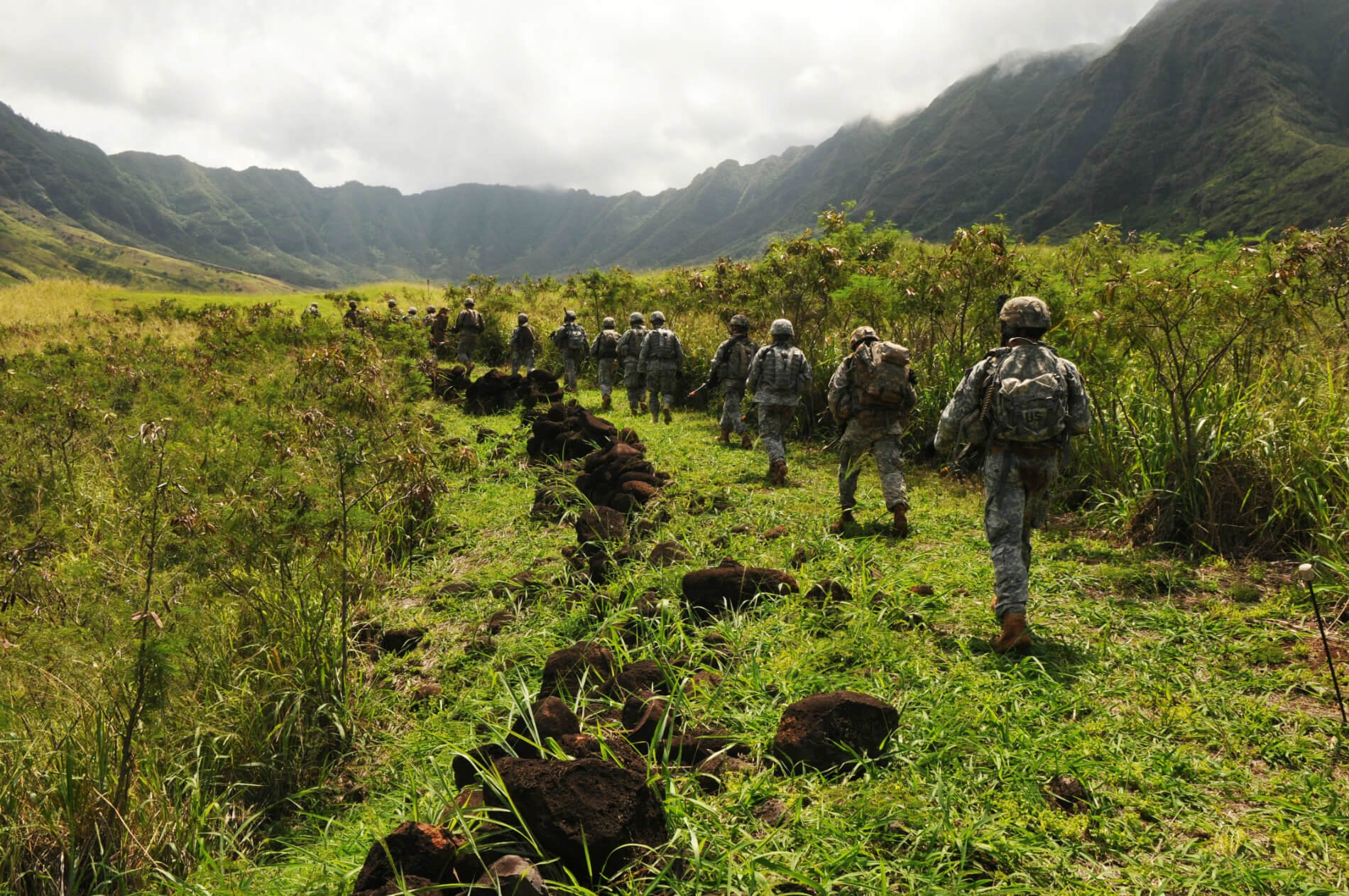
U.S. Soldiers assigned to the Bravo Company, 3rd Squadron 4th Calvary Regiment, 3rd Brigade Combat Team, 25th Infantry Division, move through an area during a training exercise, April 16, 2013 at Makua Valley, Hawaii. Image from the article: ‘Let’s Bomb This!’ US Army to Resume Live-Fire Training in Sacred Hawaiian Valley, on icmagazine.org
Deoccupation addresses this threat directly, and seeks to remedy it.
Basically, the idea is both a legal and physical course of action. It addresses a specific condition in international law: the unwanted presence or control of one state’s military over territory rightfully belonging to another country, or another people and their culture.
Deoccupation matters legally because it is rooted in foundational ideas of what treaties are, how they function, how they ought to be respected, as well as the laws of how militaries can engage in active conflict (e.g. the Geneva and Hague Conventions). Deoccupation implies the security of national borders and their integrity, proper governmental authority and its relationship to those it rules over, as well as the validity of a people’s sovereignty. The primary objective in this case is both clear and frustratingly hard to achieve: foreign troops must leave, foreign control and influence over government must end, and local government, its authority, and its operation must be restored and endorsed for and by the people.
The greatest virtue of deoccupation is the undeniable clarity and legal validity of its objective. The process of deoccupation itself contains very plain benchmarks of progress. Success is easy to understand, to track, and to verify: occupying troops pack up their bases, foreign flags are lowered, binding treaties are signed and respected, and border control returns to local authorities. By ending foreign military presence and returning civil governance to the people, deoccupation marks a clear starting point to a nation’s post-colonial era of freedom.
Both Austria and Egypt are clear examples of success in deoccupation. In the Allied deoccupation of Austria in 1955, after a decade of joint military occupation by American, British, French, and Soviet forces, all four powers signed the Austrian State Treaty, withdrew their troops, and restored a sovereign, neutral Austrian government. Similarly, under the 1979 Egypt–Israel Peace Treaty, Israeli forces demobilized and withdrew from the Sinai Peninsula by 1982, returning full territorial control and sovereignty to Egypt.
Still, despite its roadmap for success, deoccupation is not without pitfalls. The process is rife with obstacles and limitations. For example, removing foreign soldiers does not automatically fix an economy distorted by years of exploitation. Nor does it heal deeply divided and traumatized societies. While military occupation is itself a harm against the occupied, it also acts as a veneer for deeper and long-lasting harms that tend to outlive the occupation itself. We see this effect in the events following the Treaty of Manila on July 4, 1946. The Philippines established a unitary presidential constitutional republic, commonly known as the Third Philippine Republic, operating under the 1935 Philippine Constitution. But even while political institutions were established immediately, it took the government nearly another decade to achieve meaningful stability in their rule. In that time between occupation and stability, Philippine state operations were handicapped by armed civil rebellion, as well as the task of cleaning and healing the aftermath of WWII. This raises another apparent drawback in the process: while deoccupation aims to restore a form of state control that fairly supports the local population, whether those institutions are legitimate and ready to rule fairly once the authority of the occupation is no more remains an open question.
For deoccupation to work as intended, global cooperation is essential. Because international law lacks enforcement (e.g. a dedicated, and politically neutral global police force), deoccupation arguments often stall when powerful nations simply refuse to leave where they colonize.
Decolonization: Re-membering Society
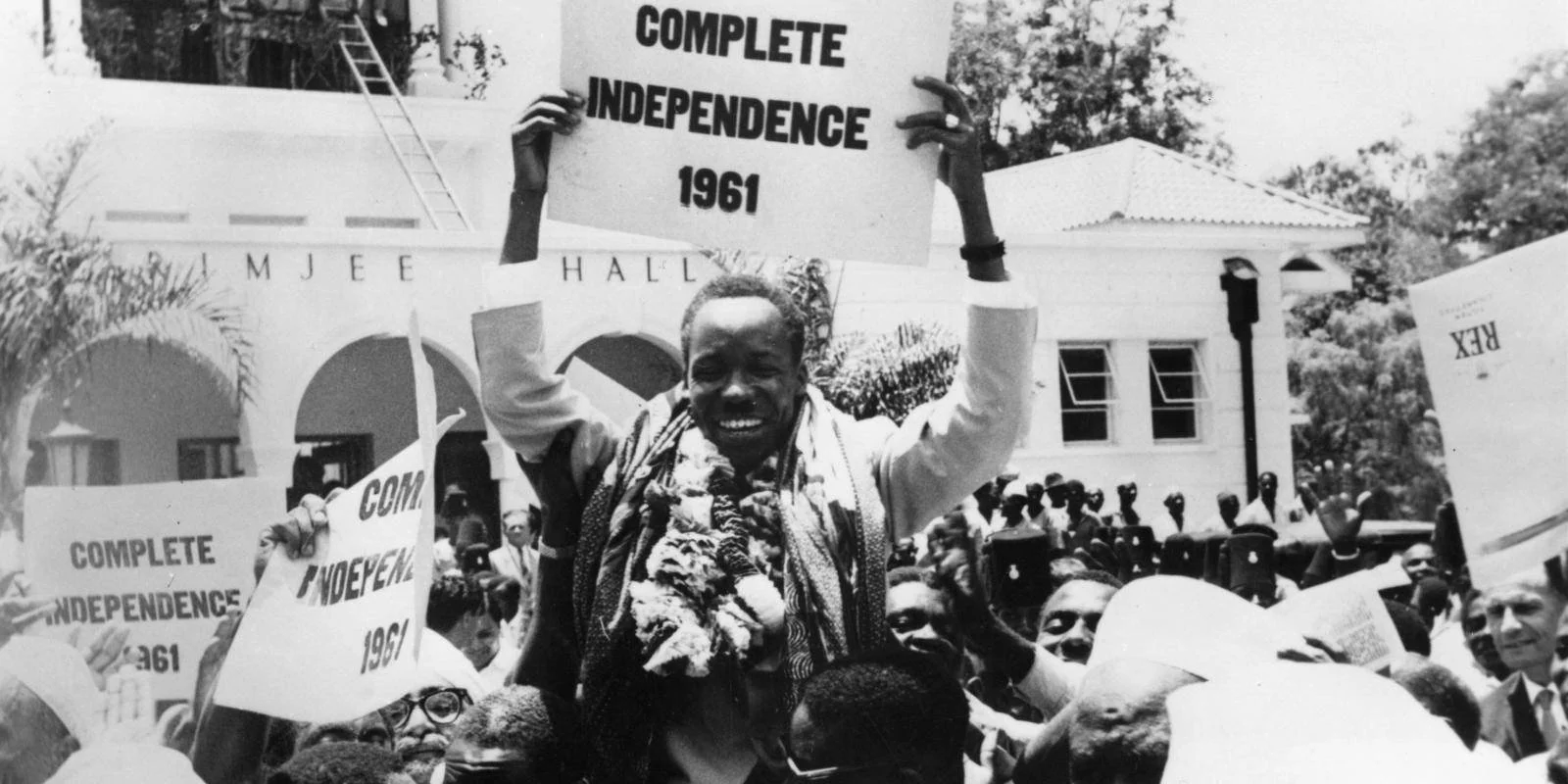
March 29, 1961; Premiere of Tanganyika (Tanzania), Julius Nyerere, celebrating with the crowd after having achieved state sovereignty for the people. Image credit: United Press International
If deoccupation focuses on legally restoring a nation, decolonization is about healing the trauma and transforming the hearts and minds of a colonized society.
When colonial power asserts itself, historically, it does not merely control land and people via occupation; it tends to rewire whole systems that support and are supported by the social fabric; it reshapes commerce to mostly benefit those in control; it imposes new languages and forms of expression; it demeans or suppresses indigenous knowledge; and it installs invasive social hierarchies that tend to persist for generations, post-colonization.
Decolonization is the intentional process of dismantling all of this.
It’s not merely an event with heavy implications in international law, like deoccupation. It more accurately speaks to generational shifts in perspective - ones that seek to directly counter, if not wholly undo, the worst harms of colonial occupation. The rectification of these harms almost necessarily demands major changes to politics, economics, culture, and even personal identity.
For instance, while fresh leadership might serve the aims of deoccupation, if those new leaders simply run (and benefit from) the same old system used under occupation, then colonization is effectively still alive and well no matter how deoccupied. This is a critical distinction between the two perspectives. To be merely free of an occupier is not sufficient for decolonization. Its achievement means seeking true economic independence and sustainability. It also includes the return of historic lands, territory, and natural resources. It could also mean an educational rejuvenation and renewal, as well as the revival and reincorporation of cultural authenticity and native traditions into society.
The first true wave of modern political decolonization happened in the mid-20th century across Asia and Africa. From the 1940s through the 1960s, countries like India, Ghana, and Algeria asserted their renewed sovereignty, as they simultaneously dismantled British and French imperial rule. Since the 2000s, decolonization has taken on new meaning through Indigenous self-determination movements in settler-colonial nations like Aotearoa (New Zealand), Canada, and the United States, where Indigenous nations push for genuine constitutional power, land rights, reparations, and cultural autonomy.
However despite its success, decolonization - like deoccupation - presents its own set of unique socio-political challenges. In a world interconnected by technology and commerce, complete economic independence is virtually impossible without sacrificing the very tools that make the current era of interconnectivity possible. The internet generally, and international e-commerce specifically, make it difficult for newly independent nations to escape global systems of economic dominance. In many cases, these economic systems tend to benefit the same countries who enriched themselves off of colonialism in the first place. But even if true economic independence were possible, because colonization touches culture, language, and commerce, it gets difficult to determine how long undoing those effects will take. There are no objective benchmarks that clearly indicate when a society is ever "fully decolonized”, with any genuine certainty. In other instances, political opportunists can occasionally hijack decolonial language to gain political power, becoming powerful demagogues. When demagogues rise to power, it’s like trading an oppressive colonial ruling class with an equally harmful local authoritarian one. In those cases, the underlying social and economic inequality started under colonialism carries on long after the last colonizer leaves for good.
How the Paths Intersect: Hawaii’s Road to Freedom
Imagine that a colonizing nation withdraws their military from their former colony, but leaves behind a system of debts that drains local wealth; or perhaps they’ve left the economy hollowed and vulnerable to foreign control; or perhaps colonial narratives are still entrenched in the local education system in a way that erases local history and devalues local people. In any of these circumstances, even though the land may have been deoccupied, the former colony is far from decolonized.
Deoccupation and decolonization are neither opposites nor enemies; they both contrast each other mutually as much as they compliment each other. Both ideas act as overlapping yet wholly distinct stages of political freedom. Deoccupation reclaims physical spaces and reestablishes their legal integrity, while decolonization (re)builds society within that space from the inside, out.
When we apply these two concepts to Hawai’i, it becomes easier to see how these two ideas support each other in spirit, while diverging in practice: a deoccupied Hawai’i focuses on the legalities of restoring sovereignty and reestablishing a Hawaiian nation that the international community actively recognizes; a decolonized Hawai’i focuses on realigning a revived Hawaiian nation with public values and social systems consistent with Hawaiian culture.
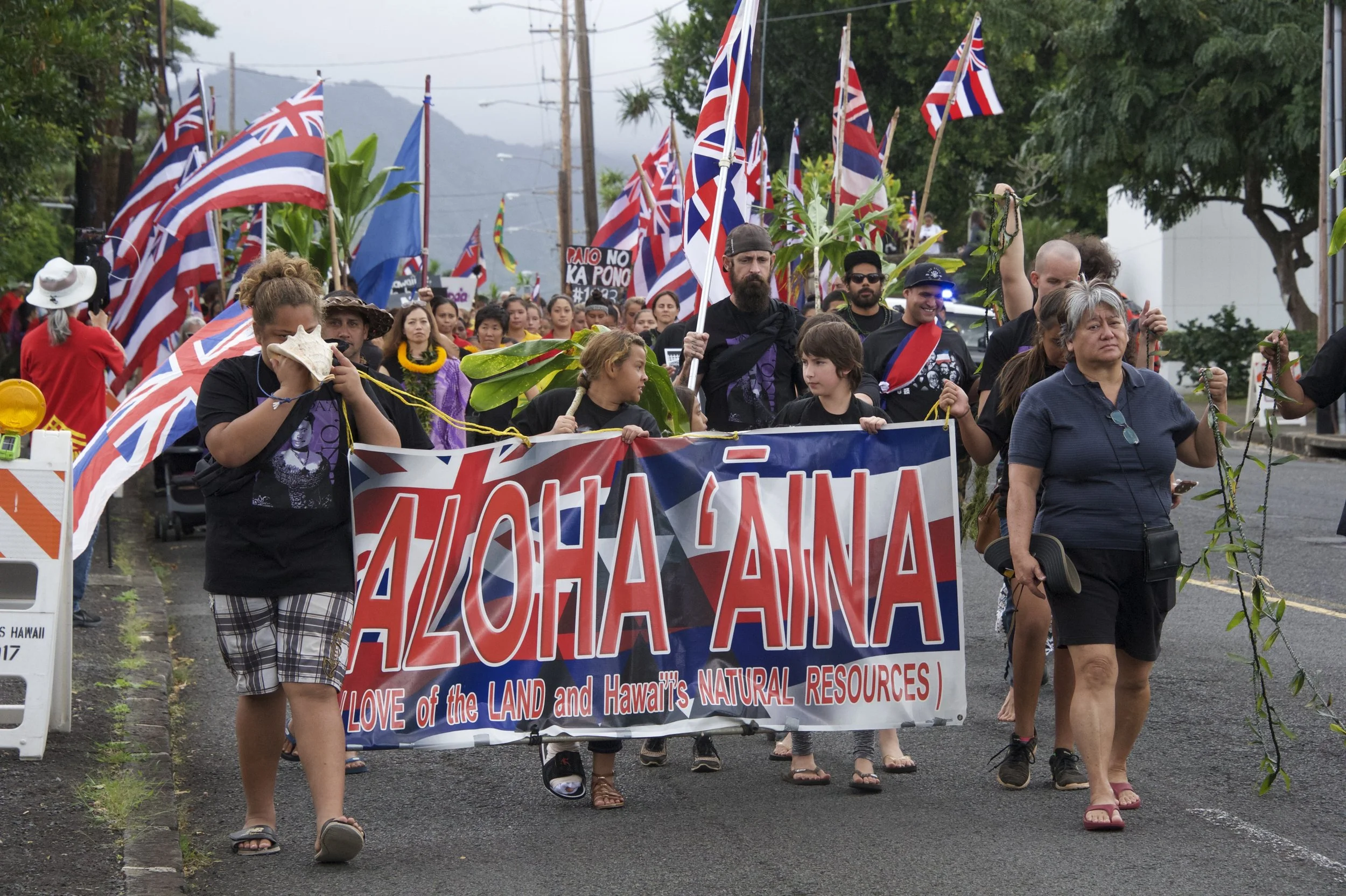
The Onipaʻa Peace March, an annual commemorative demonstration observing the January 17, 1893 overthrow of Queen Liliʻuokalani; January 17, 2018. Image credit: Honolulu Star-Advertiser staff photographer.
Imagine Hawai’i Deoccupied…
This initiative emphasizes the critical importance of international law and its relevance to the legal continuity of an independent Hawaiian nation. Specifically, it unapologetically asserts that the nation of Hawai’i remains an autonomous state under temporary, unauthorized occupation since the 1893 overthrow of Queen Lili’uokalani, as well as the subsequent 1898 annexation facilitated by US-backed usurpers.
In this scenario, deoccupation is an international legal process:
Military Withdrawal: The largest and most obvious change would be the full closure and unconditional withdrawal of 11 active, major US military installations, and their troops, across the islands (including Schofield Barracks, Kaneohe MCB, Hickam, Pearl Harbor Naval Station, Pohakuloa Training Facility, etc.), returning control of vast tracts of land and shoreline to local stewardship or state executive authority.
Restoration of Nationhood: Control over Hawai’i by Washington DC and the US-backed Hawai’i State government would incrementally wind down and ultimately end. The re-establishment of a sovereign Hawaiian nation recognized under international law would activate to replace it.
Legal Continuity: The reestablished nation of Hawai’i succeeds, ultimately, when it accumulates valid international treaties, rightfully reestablishes border recognition to the international community, and formally reinstates an operational Hawaiian government to the world’s nations and their leaders.
Imagine Hawai’i Decolonized…
A Hawaiian nation moving through decolonization looks beyond international legal structures to focus on the deep restoration of the land (ʻāina), culture, and people. It asks how society ought to operate on a daily basis, regardless of international politics, formalities, or legalities.
A decolonized Hawaii reflects a real systemic transformation:
Economic Restructuring: The islands would transition away from over-reliance on an extractive, real-estate-driven mass tourism economy. Economic priorities would then re-center on local sustainability, food security, and diversified local enterprise.
Ecological Restoration (Aloha ʻĀina): Decolonization would prioritize repairing damaged ecosystems through traditional agricultural and resource-management practices—such as restoring loʻi kalo (taro patches) and loko iʻa (fishponds)—putting ecological health and community nourishment ahead of commercial development.
Cultural and Social Renewal:ʻŌlelo Hawaiʻi (the Hawaiian language), traditional Hawaiian legal concepts, and Native Hawaiian educational models would move from the margins of island living to the epicenter of public life, political policy, and community health.
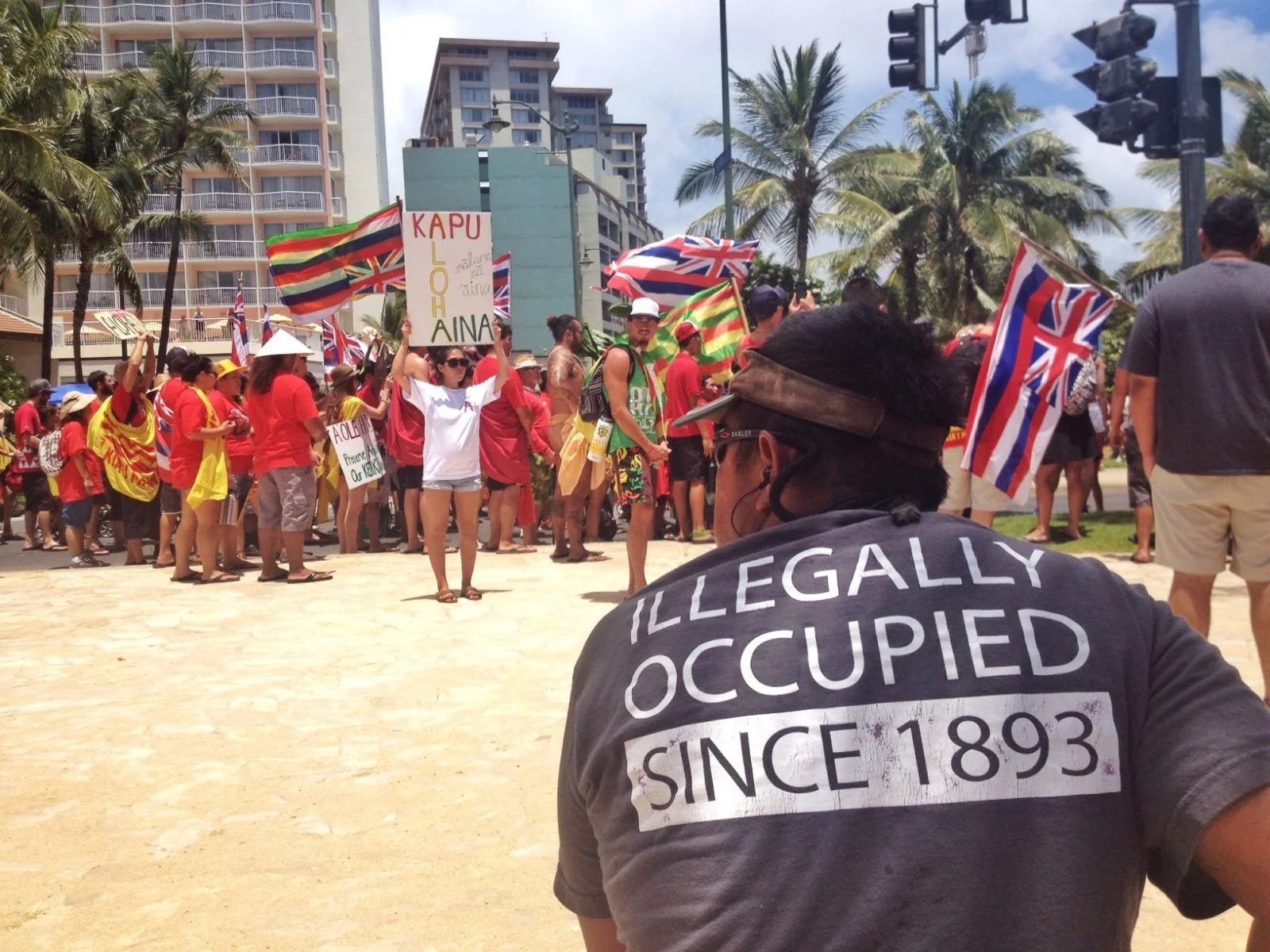
The Aloha ʻĀina Unity March, August 9, 2015; photographer unknown
Imagine a Restored Hawaiian Nation
Deoccupying Hawaii addresses the legal status of the land and state under international law, focusing on who holds legal authority and where foreign militaries can operate. Decolonizing Hawaii addresses living the values and restoring the social fabric of the islands—healing relationships between the history, the people, and the land; restoring indigenous wisdom; and reshaping the economy so that the community thrives on its own terms.
If a real post-American Hawaiian nation is ever meant to be, true self-determination properly requires both the legal freedom to govern without foreign interference, and the cultural and economic strength to build a healthy and self-sustaining society.
